Cash payment: Cash limits in Europe
If you want to pay large sums of money abroad in the EU, for example when buying a car, there are a few rules you need to follow.
This is because many EU countries have cash limits. This means that cash payments can only be made up to a certain amount.
Inhaltsverzeichnis
EU-wide single limit for cash payments from summer 2027
There is still no EU-wide upper limit for cash payments. But there will be one.
As part of the fight against money laundering and terrorist financing, EU lawmakers have decided to set a single limit of €10,000. Following the European Parliament’s approval in April 2024, the Council of Ministers also approved the regulation at the end of May 2024. As soon as the regulation is published in the Official Journal of the EU, it can enter into force. However, the new regulation will only apply three years after its entry into force, i.e. probably from summer 2027.
The limit will not apply to transactions between private individuals who are not engaged in a commercial activity.
Member States that already have lower cash limits may retain them.
Important to know
- In euro countries, there is no obligation to accept more than 50 coins at a time.
- It may also happen that traders refuse larger euro notes (e.g. a €200 note).
- Anyone entering or leaving the EU with a total of more than €10,000 in cash must declare it to national customs.
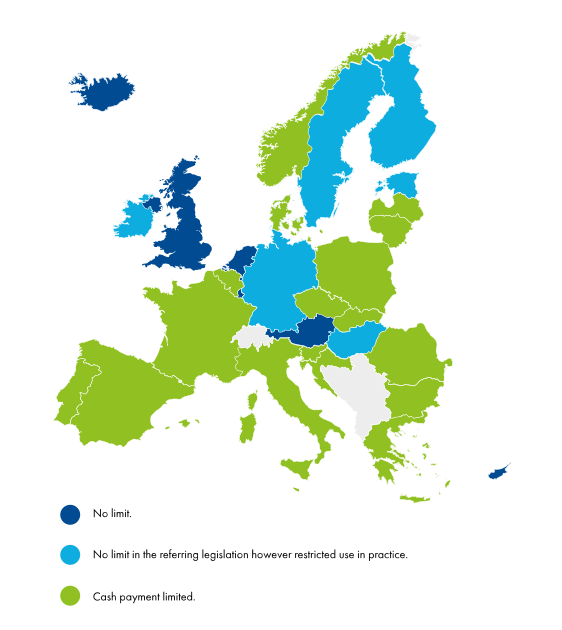
Click on each country to find out more about cash limits.*
No limit.
- For goods and services, the limit for cash payments is EUR 3,000. This restriction does not apply to payments between consumers.
According to Belgian law, special regulations include the following:
- The purchase price for the acquisition of real estate may not be paid in cash.
- If copper cables are sold to a entrepreneur, the entrepreneur may not pay the purchase price in cash. Not even if the seller is a consumer.
- When buying and selling scrap metal and items containing valuable materials, cash payments between entrepreneurs are prohibited.
- If a consumer sells such valuable materials to an entrepreneur, the payment may only be made in cash up to an amount of 500 euros. The entrepreneur must also verify the identity of the selling consumer.
These restrictions do not apply if the execution of the contract takes place under the supervision of a bailiff.
Violations of the above restrictions are punishable by fines ranging from 250 euros to 225,000 euros.
Amounts of 10,000 levs (approx. 5,108 euros) or more may not be paid in cash. This also applies if this limit is only reached through several related payments.
Violations can be punished with a fine of up to 25 percent of the sum concerned (for entrepreneurs up to 50 percent).
For payments in another currency, the limit of 10,000 levs is set according to the exchange rate of the Bulgarian National Bank on the day of payment.
No limit.
From January 2023 the following will apply: Legal or natural persons carrying out a registered activity in Croatia may not accept cash payments of 10,000 euros or more.
Cash payments are possible up to and including 270,000 Czech crowns (approx. € 10,509) per day.
Violations of this rule are punishable by a fine of up to 500,000 kroner for consumers and up to 5,000,000 kroner for companies.
Here you can read the Czech legal text (in English).
No limit on cash payments between private individuals.
As soon as an entrepreneur is involved, however, there is in fact a maximum limit.
Because in Danish law there are, among other things, the following special regulations:
- Traders are not allowed to accept cash payments of 20,000 Danish kroner (approx. 2689 euros) or more. This does not apply to banks and other financial service providers.
- Traders are obliged to accept cash up to 20,000 kroner between 6 a.m. and 10 p.m. (in areas with a high crime rate until 8 p.m.). The obligation applies when traders accept certain types of payment, especially card payment.
- The use of 500-euro notes as well as 25-Øre coins is prohibited.
- When paying an amount in coins, a maximum of 25 coins per transaction may be used. The maximum amount that may be paid exclusively in coins is DK 962.50 (approx. 129 euros).
- For services or purchases of goods related to services, cash payment is not recommended for amounts of DK 8,000 (approx. 1075 euros) or more. The reason: if the trader does not pay the income tax and VAT on the purchase price, the consumer can be held jointly responsible. The buyer can exempt himself from this liability by reporting the purchase to the competent tax office (within 14 days after payment, at the latest one month after receipt of the invoice).
Below you will find the relevant Danish laws (in Danish):
No limit on cash payments.
Cash can be rejected from 50 coins or banknotes, regardless of the value.
The Estonian central bank as well as credit institutions, on the other hand, must accept cash / banknotes without any restriction.
There is no legal limit for cash payments.
However, the trader is also not legally obliged to always accept cash payments. Such procedures must be clearly communicated, for example in the form of signs at the entrance of a shop, e.g. refusing to accept more than 50 coins or a large banknote.
Read more about paying cash in Finland.
he limits for cash payments are as follows:
- The cash limit is 1,000 euros for taxpayers resident in France.
- For non-resident taxpayers acting as consumers, the limit increases to 15,000 euros.
- Payments in connection with property purchases that are notarised may be paid in cash up to a maximum of 3,000 euros.
- Cash payments between private individuals, for example when buying a car, are not limited. The issuing of an invoice is mandatory for amounts over 1,500 euros in order to be able to prove payment.
- Taxes can be paid in cash up to a maximum of 300 euros.
Traders are obliged to accept cash, otherwise a fine of max. 150 euros may be imposed.
Traders may refuse to accept damaged banknotes. The same applies if there are safety concerns (for example, if a payment is made at night). If there is any doubt about the authenticity of the banknote, the merchant may ask you for your identity and the origin of the banknote.
Traders are allowed to refuse payments with more than 50 coins, as well as banknotes that significantly exceed the amount to be paid.
Below you will find corresponding French laws and further information (in French):
There is no upper limit for cash payments.
However, anyone wishing to pay more than €10,000 in cash must show identification. The merchant must then collect the following information Name, first name, place and date of birth, nationality and home address. This information must be recorded and retained by the dealer.
For the anonymous purchase of precious metals (gold, silver, platinum, etc.), a cash payment limit of 1,999.99 euros has applied since January 2020. For precious metal purchases above this amount that are paid for in cash, the retailer must verify the identity of the customer.
Since 1 April 2023, cash payment for the purchase of real estate has been prohibited.
The maximum limit for cash payments is 500 euros.
Higher amounts must be paid by bank transfer, bank card or cheque.
There is no cash limit for car purchases.
In Greece, there is talk of changing the law to limit cash payments to 200 euros.
Consumers can pay in cash without restriction.
A limit of 1.5 million Hungarian HUF (approx. 41,695 euros) per month applies to legal entities, business associations and individuals who are subject to VAT.
No limit.
According to the law, there is no limit for cash payments.
In practice, however, it may well happen that traders only accept cash up to a certain amount.
Italy has raised the limit for cash payments.
From January 2023, the limit for cash payments will be €5,000 (previously €2,000).
The maximum amount that can be paid in cash is 7,200 euros.
Violations are sanctioned with fines amounting to 15 percent of the sum concerned.
Land purchase contracts may generally not be carried out with cash.
As of November 2022, the cash payment limit for natural and legal persons will be 5000 euros.
No limit for cash payments.
However, for cash payments of €10,000 or more, merchants must verify the identity of the customer, keep the documents for at least 5 years and inform the competent authority in Luxembourg if money laundering is suspected.
Certain items and goods may not be paid for in cash for an amount of 10,000 euros or more. This includes antiques, real estate, jewelry, precious metals, pearls, precious stones, automobiles, boats, and works of art.
Violations will be punished with a fine of at least 40 percent of the amount in question.
To the Maltese legal text (in English).
There is currently no limit on cash payments to private individuals.
However, for cash payments of €10,000 or more, the seller is obliged to carry out a detailed check on the customer (customer due diligence).
The seller can also decide whether to accept cash at all or only up to a certain amount.
There is an obligation to report suspicious payments over €2,000. This applies, for example, to the banking sector, freelancers, insurance companies and casinos.
The Dutch government is working on a bill that would ban cash payments above €3,000.
In Norway there is a right to pay with cash.
There is no limit for cash payments between individuals.
However, as soon as an entrepreneur is involved, there is in fact a maximum limit.
The Norwegian law sets the following restrictions:
- When paying for items with a value of up to and including 40,000 Norwegian kroner (approx. 3841 euros), the seller may not accept a cash payment. This also applies if the amount is paid in several installments.
- When purchasing services or goods related to services, cash payments are not recommended if the amount exceeds 10,000 Norwegian kroner (approx. € 958). The reason: if the service provider does not pay income tax, VAT and social security contributions, the consumer can be held responsible.
- When paying an amount in cash, no more than 25 coins per unit must be accepted.
You can find relevant Norwegian laws here (in Norwegian):
- Lov om Norges Bank og pengevesenet mv. (sentralbankloven)
- Lov om tiltak mot hvitvasking og terrorfinansiering (hvitvaskingsloven)
- Lov om betaling og innkreving av skatte- og avgiftskrav (skattebetalingsloven)
For payments between traders, the limit for cash payments is PLN 15,000 (approx. EUR 3300).
If natural persons are involved, there are no limits.
Changes to cash limits in Poland planned for January 2024 have been abandoned.
Payments of a value of 3,000 euros or more may not be made in cash.
The Portuguese law also contains the following separate regulations:
- For a person liable to income or corporate tax in Portugal, cash payments of 1,000 euros or more are not permitted.
- If the payment is made by a consumer who does not have a place of residence in Portugal, cash payments are only prohibited from an amount of 10,000 euros or more.
- Taxes may only be paid in cash up to and including 500 euros.
Payments to entrepreneurs may only be made in cash as long as they do not exceed 5,000 Romanian lei (approx. € 1016) per day.
For the delivery of goods and services, this limit is 10,000 lei (approx. € 2033) per day.
Payments between consumers, e.g. for the purchase of a good, service or for rent, may only be made in cash as long as the amount is below 50,000 lei (approx. €10,165) per day.
From 1 July 2023, the cash payment limit for all natural and legal persons in Slovakia will be €15,000.
Traders are only allowed to accept cash payments up to and including 5,000 euros.
Payments to traders or from traders may no longer be made in cash from an amount of 1,000 euros or more.
For a consumer who does not have a tax residence in Spain, the ban on cash only applies to an amount of 10,000 euros or more.
If this rule is violated, the penalty is 25 percent of the sum concerned.
You can find relevant Spanish laws here (in Spanish):
There is no limit for paying with cash.
However, a trader can refuse to accept cash. This must then be made known clearly and in good time (for example by means of a corresponding sign in front of a shop).
Healthcare services must always accept cash payments.
More information in Swedish can be found here.
The consumers can make cash payments without any limits.
The traders, however, need to register themselves with tax authorities as ‘High Value Dealers’ if accepting cash payments in excess of € 10,000. Exclusions apply.
Good to know: In England and Wales, you pay with English pound notes. However, in Scotland and Northern Ireland, the English pound notes may not be accepted. Likewise, the Scottish and Northern Irish pound notes may not be accepted in shops in England and Wales.
With regard to the change, there are unlimited payments of £ 5, £ 2 and £ 1. Coins with a face value of 50p, 25p and 20p can pay amounts up to £ 10, with 10p and 5p up to £ 5 and with 2p and 1p up to 20p.
Below you will find relevant UK legislation and further information:
*The information comes from our colleagues in the European Consumer Centres Network and was last checked in 2023. We make no claim to completeness.
Das könnte Sie auch interessieren
Funded by the European Union. Views and opinions expressed are however those of the author(s) only and do not necessarily reflect those of the European Union or the European Innovation Council and Small and Medium-sized Enterprises Executive Agency (EISMEA). Neither the European Union nor the granting authority can be held responsible for them.
Was this article helpful for you?